The mental load doesn't stay at home
HR leaders estimate 30% of their people are quietly burning out. A lot of what they're carrying started at home. What the research says, and what helps.

Long story short
- HR leaders estimate 30% of their people are quietly burning out, and 40% of employees who've been through burnout describe presenteeism
- A 2024 study of 3,000 US parents found mothers track 71% of household tasks and fathers 45%, with the widest gap in the daily ones
- Seven in ten working parents deal with parenting during working hours, and 59% say work comes into family time as well
- 34% of employees either aren't offered mental health benefits or don't know whether they are
- The fix is structural on both sides: clearer ownership at work, and one shared place for the family week at home
It's 2026, and we have access to more information and more opportunities than ever before. On paper this sounds great, but in reality it means life moves faster and expectations are on the rise. Both at work and at home. Unfortunately the two don't talk to each other to plan your resources accordingly, but the effects do cross the divide.
So, as an employer, how do you support the invisible load being carried at home to better allow your teams to thrive at work?
Most of it you can't see
Spring Health's 2026 Workplace Mental Health Annual Report asked HR leaders how many of their people they thought were quietly burning out. The estimate came back at 30%.
The same report found that 40% of employees who've been through burnout describe presenteeism. At their desk, signed in, mentally somewhere else. Someone's in the room and only part of them is there, and from the outside it looks like an ordinary Tuesday.
That's over 2,000 HR leaders and employees across five countries, at organizations with 500 people or more, so it isn't a niche finding. And it sits awkwardly next to another number in the same report: only 9% of HR leaders say their current mental health solution is clearly bringing health plan spend down.
So the problem is recognized and the spending is happening. Something in between isn't connecting.
What they're carrying when they get to work
Some of the load your team arrives with was generated hours earlier, in the home, or the playground, or in the car on the way to school.
A 2024 study in the Journal of Marriage and Family, run by researchers at the University of Bath and the University of Melbourne, surveyed 3,000 American parents. It looked at seven categories of what they call domestic cognitive labor: cleaning, scheduling, childcare, maintenance and repairs, finances, social relationships and cooking. Not who does the task. Who keeps track of it.
Mothers came out responsible for 71% of the tasks measured, fathers for 45%. Those two numbers overlap, because both parents can be involved in the same category, which is why you may see these numbers incorrectly reported. The widest gap was in the daily things, cleaning and childcare, at 79% against 37%. Fathers carried more of the occasional work, finances and repairs, at 65%.
One of its authors said the work is often unseen but that it matters, that it leads to stress and burnout and can affect women's careers.
One small example from our house. Our 11-year-old couldn't remember her gym bag. Or her tennis gear, or which day needed which. So Mum became the reminder, out loud, every morning, the same list. It worked, in the sense that the bag usually got to school, and it was a sub par solution for both of them.
The bag was never the hard part. Packing a bag takes four minutes. The weight was in holding the whole schedule, permanently, and being available to recite it at 07:20. None of which stops at 07:20. It picks up again at 09:40, in a meeting, while somebody's manager asks a question about Q3.
The traffic runs both ways
In March 2026, Pew Research Center asked 2,242 American working parents how the two halves of their lives overlap. Seven in ten deal with parenting during working hours. Among mothers, 38% said extremely or very often, against 17% of fathers. And 59% said work comes into family time as well.
One person in that survey put it better than any of the analysis around it: "I'm supposed to work like I don't have kids and supposed to parent like I don't have a job."
A word on the sources. The Bath and Pew studies are both American. We're Norwegian, where parental leave is longer, the father's quota exists and childcare is split more evenly, so we'd expect a narrower gap here. Nobody has run those same seven categories on a Nordic sample as far as we can find. Take the pattern and leave the percentages. The Spring Health numbers cover five countries including the UK, and measure workplace mental health broadly rather than anything about households.
Why the benefits you already pay for might be missing
Mental health support is now a retention question. Spring Health found 69% of employees say those benefits are very or extremely important when they're deciding whether to take a job or stay in one.
The same survey found 34% of employees either aren't offered mental health benefits or don't know whether they are. A third of your people might be unsure what's available to them.
Harvard Business Review ran an article in July 2026 called "The Invisible Work Draining Your Best Employees", arguing that leaders measure hours, deadlines and output and miss the coordination sitting underneath all three. One of the researchers behind that 2024 household study is among its six authors, which is a useful bit of continuity. The people who counted this at the kitchen table are now writing about it for managers.
Their conclusion: "Managing mental load is less about reducing work itself than about redesigning how it is structured and distributed, so employees can sustain focus, effectiveness, and engagement."
Which is to say the fix is structural.
What actually helps
Start with the work part, the half you actually have oversight of.
The HBR authors are a better guide here than we are, and their advice is unglamorous. Fewer decisions left hanging overnight. Clear ownership, so nobody's quietly tracking a thing that was never actually assigned to them. Meetings that finish with somebody saying out loud who's doing what. Every one of those reduces how much work goes home in a head, and none of them has a license fee.
This isn't the half we can help with, unfortunately.
The home half is the one we're really here to talk about, and it's actually much the same as at work. It's about closing the mental loops, sharing accountability, and getting everything somewhere you can trust.
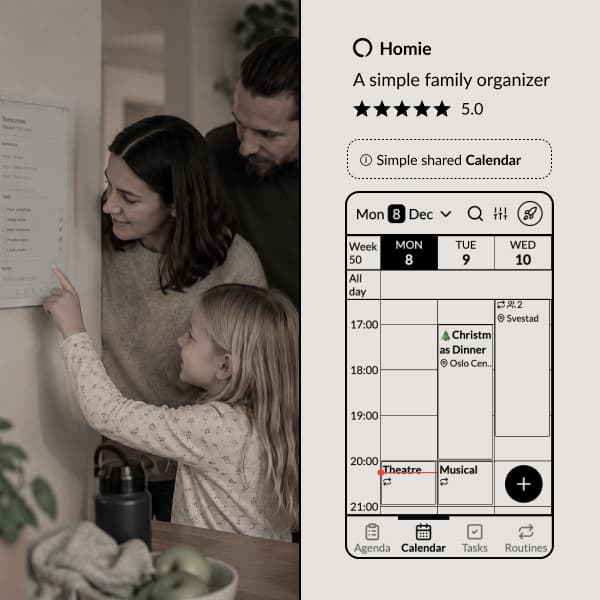
One practical step to take. Put everything for the week in one place that everyone can see. Events, to-dos, routines, shopping lists, notes, no longer living in one person's head.
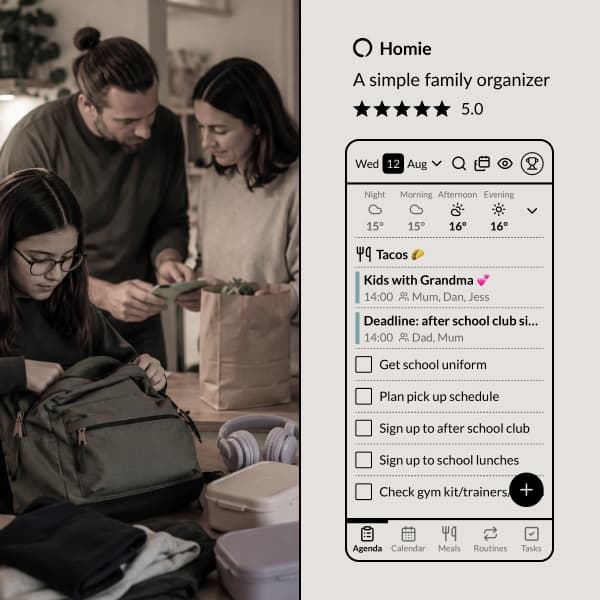
Here's how we've solved it in the Homie app:
Your agenda
of events, tasks, meals, and routines for the day.
The first challenge is finding a system that works, the second is getting the whole family to use it. We built Homie to help do these two things.
Some employers have started offering Homie to their staff. There's a page about that if it's relevant to you. The first year is free, so employers can see the value before they decide whether to continue to offer Homie.
What actually relieves it
Getting it out of your head and into a system you trust does one specific thing. It closes the open loops. The part of a person that keeps checking whether the dentist is really booked can finally stop, because the answer is somewhere reliable. That's a genuine relief, and a limited one, because the list is still theirs.
Sharing it is where the weight moves. Once the week is open to the people whose week it is, the knowing stops being a job with one name on it.
Being organized and being relieved aren't the same. One person can run a household beautifully and still be the person the whole thing rests on. The relief arrives when that stops being true, when nobody is carrying the success of the family on their own.
The load doesn't go anywhere. The permission slip still needs signing, the Q3 question still needs answering, and something still gets forgotten about once a fortnight, usually swimming. But the load is now shared, the loops are closed rather than running in one person's head, and everything feels a little bit calmer.
In a world where words like rage bait and slop are the words of the year, it feels like a good moment for some calm. Find out more about how Homie brings calm to family life and how employers can be a part of this.
Sources
- Spring Health, 2026 Workplace Mental Health Annual Report, published April 2026. Over 2,000 HR leaders and employees across five countries; HR survey at organizations with 500+ employees in the US, Canada, Mexico, India and the UK. Report · Ten headline statistics · Announcement
- Weeks, A. C. and Ruppanner, L., Journal of Marriage and Family, December 2024. 3,000 US parents, seven categories of domestic cognitive labor. University of Bath announcement
- Pew Research Center, "For Working Parents, the Boundary Between Work and Family Is Often Blurred", 16 June 2026. 2,242 US working parents, fieldwork 2 to 15 March 2026. Full report
- Ruppanner, L., Swenson, H., Mangino, K., Stuart, H. C., Smith, D. G. and Dickens, M., "The Invisible Work Draining Your Best Employees", Harvard Business Review, 24 July 2026. Article
Explore Homie
Making busy family life
CALMER
Homie is a simple, yet powerful operating system for your family, so you can stop chasing schedules as the family's notification system.
Ready to organize your family?
Try Homie free and see how simple family organization can be.