Calm Technology: The Counter-Movement to Big Tech's Attention Economy
While Big Tech designs products to maximize your screen time, a growing movement is building technology that respects your attention. Here's what Calm Technology is—and why it matters for families.

Long story short
- Big Tech's business model depends on capturing and monetizing your attention
- 210 million people worldwide are estimated to be addicted to social media
- Calm Technology is a design philosophy dating back to 1995 that prioritizes human well-being over engagement
- The Calm Tech Institute now certifies products that respect users' attention
- Companies like Mudita, reMarkable, and Daylight are building technology designed to be used less
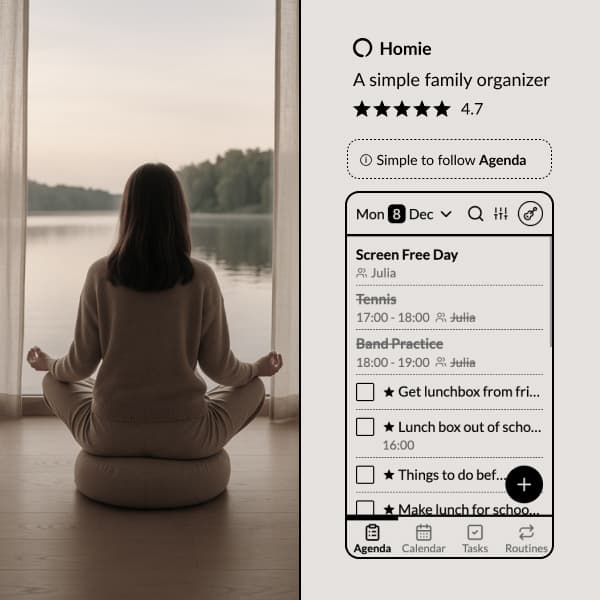
- Homie's "intentionally boring" design aligns with Calm Technology principles
It's 7pm. You're trying to have dinner with your family, but your phone keeps buzzing. Instagram notifications. Email alerts. That app you downloaded last week wants you to "complete your streak." Your teenager is scrolling TikTok under the table. Your partner is "just checking one thing" that turns into fifteen minutes.
This isn't a failure of willpower. This is technology working exactly as designed.
The Attention Economy
Here's an uncomfortable truth: most of the technology we use every day is specifically engineered to be addictive.
The business model is simple. Companies like Meta, TikTok, and Google make money from advertising. The more time you spend on their platforms, the more ads they can show you. So they hire the world's best engineers and psychologists to figure out how to keep you scrolling, clicking, and coming back.
The techniques are well-documented: intermittent variable rewards (like a slot machine, you never know when the next dopamine hit is coming), infinite scroll (no natural stopping point), push notifications (interrupting whatever you're doing), and social approval mechanisms (likes, comments, followers) that tap into our deepest needs for connection and validation.
The result? According to recent studies, 210 million people worldwide show signs of social media addiction. 47% of teenagers report feeling addicted to their phones. Teens now spend an average of 4.8 hours per day on social media alone—not counting other screen time.
The mental health correlations are stark. Heavy social media use is associated with a 70% increase in depression and anxiety symptoms. Seven in ten teens using social media more than five hours daily show higher risk factors for suicide.
"Your Attention Didn't Wander—It Was Stolen"
In 2020, the Netflix documentary The Social Dilemma brought these issues into mainstream awareness. Former tech insiders—including designers and engineers from Google, Facebook, Twitter, and Pinterest—explained how they built the systems now causing widespread harm.
Tristan Harris, a former Google design ethicist featured in the documentary, puts it bluntly: "If you're not paying for the product, you are the product."
Harris went on to found the Center for Humane Technology, an organization dedicated to shifting the tech industry away from extractive attention economics toward designs that prioritize human well-being. Their core argument: technology companies should become "fiduciaries to our values"—legally and ethically bound to act in users' best interests, not against them.
The Center's work has influenced major platforms to adopt "time well spent" features like screen time reports and notification management. But critics argue these are band-aids on a fundamental problem: the business model itself.
A Different Vision: Calm Technology
While the attention economy was taking shape in Silicon Valley boardrooms, a very different vision of technology was emerging in research labs.
In 1995, two researchers at Xerox PARC—Mark Weiser and John Seely Brown—published a paper called "Designing Calm Technology." Their insight was simple but profound:
"Technology should simplify complexities, not introduce new ones."
Weiser and Brown imagined a future where technology would fade into the background of our lives, supporting us without demanding constant attention. They called this "calm technology"—technology that informs without overwhelming, assists without intruding.
Their famous example was the "Dangling String"—a plastic rope connected to the office network that would spin faster when network traffic increased. You could glance at it and know the network status without looking at a screen, checking a dashboard, or being interrupted by an alert. The information was there when you needed it, invisible when you didn't.
This was 1995—before smartphones, before social media, before the attention economy. They were describing a path not taken.
The Modern Calm Tech Movement
For two decades, Weiser and Brown's vision remained largely academic. Then, in 2015, a researcher and designer named Amber Case published Calm Technology: Principles and Patterns for Non-Intrusive Design through O'Reilly Media.
Case took the original research and translated it into practical design principles for the modern world. Her work caught on with designers frustrated by the industry's race to the bottom of the attention economy.
She defines calm technology this way:
"Calm technology describes a state of technological maturity where a user's primary task is not computing, but being human."
In 2024, Case founded the Calm Tech Institute and launched what she calls "the world's first standard for attention and technology"—the Calm Tech Certified program.
The Eight Principles of Calm Technology
Case distilled Weiser and Brown's research into eight practical principles:
1. Technology should require the smallest possible amount of attention.
Design for glanceability. If something can be communicated in the periphery of attention rather than demanding focus, it should be.
2. Technology should inform and create calm.
Good technology doesn't create anxiety—it resolves it. It gives you information you need without making you worry about information you don't.
3. Technology should make use of the periphery.
Not everything needs to be front and center. Think of a wall clock: you can see the time with a quick glance, but it doesn't demand your attention.
4. Technology should amplify the best of technology AND humanity.
Technology should help us be more human, not less. It should support our relationships, our creativity, our well-being—not undermine them.
5. Technology can communicate, but doesn't need to speak.
Haptics, ambient light, subtle sounds—there are many ways to convey information without demanding focused attention.
6. Technology should work even when it fails.
Good design degrades gracefully. If the smart system fails, the basic function should still work.
7. The right amount of technology is the minimum needed to solve the problem.
More features isn't always better. Often, constraints are a gift.
8. Technology should respect social norms.
Technology that interrupts conversations, disrupts family dinners, or makes social situations awkward has failed at a fundamental level.
Calm Tech Certified: A New Standard
In October 2024, Case and the Calm Tech Institute launched the Calm Tech Certified program—an 81-point certification standard evaluating products across six dimensions: Attention, Periphery, Durability, Light, Sound, and Materials.
Products can achieve three tiers: Certified, Gold, or Platinum—the highest recognition.
The certification represents a bet that consumers increasingly want technology that respects their attention, and that companies building such products deserve recognition and marketplace differentiation.
Companies Building Calm Technology
A growing ecosystem of companies is now building products designed around calm technology principles. Here are some notable examples:
Mudita (Poland) — Platinum Certified
Perhaps the most committed company in the calm tech space is Mudita, a Polish company building what they call "technology for well-being."
Their flagship product, the Mudita Kompakt, is a minimalist phone with an e-ink display. No tracking. No ads. No social media apps. No infinite scroll. It has physical hardware switches that let you disconnect the microphone and camera entirely.
Mudita also makes the Harmony 2 and Bell 2—minimalist alarm clocks designed to help you sleep without the temptation of a smartphone on your nightstand.
Their philosophy is explicit:
"Technology should reduce stress and support intentional living."
In 2025, Mudita's products received both the Red Dot Design Award and the iF Design Award, alongside Platinum certification from the Calm Tech Institute.
reMarkable (Norway)
The reMarkable paper tablet took a radical approach: an e-ink device designed only for reading and writing. No app store. No web browser. No notifications. No widgets. The device doesn't even display the time unless you specifically ask.
These aren't missing features—they're intentional constraints. By removing distractions, reMarkable creates space for focused work.
Daylight Computer (USA)
Daylight is building what they call "the world's first 60Hz e-paper computer"—a full-featured computing device designed to not disrupt your circadian rhythm. It works outdoors in sunlight and doesn't emit the blue light that interferes with sleep.
Mui Board (Japan)
The Mui Board is a smart home interface disguised as a piece of decorative wood. The screen only appears when you touch it, otherwise showing beautiful natural wood grain. It's technology that becomes invisible when not in use—ambient awareness without visual pollution.
Unpluq (Spain)
Unpluq takes a physical approach to digital well-being: a small keychain tag that "locks" designated apps on your phone. To use the locked apps, you need to physically tap the tag. It's a concrete, tangible friction that makes you conscious of your digital habits.
What These Products Have in Common
These companies come from different countries, build different products, and serve different needs. But they share core principles:
- They're designed to be used less, not more
- They respect attention as a finite, precious resource
- They embrace constraints as features, not limitations
- They prioritize function over engagement metrics
- They measure success by user well-being, not time-on-device
This is the opposite of the attention economy. And it's a growing market.
Why This Matters for Families
If the attention economy is harmful for adults, it's devastating for children.
Kids' brains are still developing. They're more susceptible to addictive design patterns. They have less capacity for self-regulation. And they're growing up in a world where their attention is being systematically harvested from the moment they first touch a screen.
Parents, meanwhile, are caught in the middle—trying to model healthy technology use while being just as hooked as their kids. We tell our children to put down their phones while scrolling through our own notifications. We set screen time limits we can't keep ourselves.
And the cognitive load of managing a family's schedule, tasks, and communication increasingly happens through apps designed to keep us engaged, not to help us disengage.
The average parent now spends significant mental energy managing technology itself—updating apps, adjusting notification settings, monitoring screen time, researching which apps are safe. This is energy not available for actual parenting.
How Homie Thinks About Attention
When we built Homie, we didn't know the term "calm technology." But we knew what we didn't want to build.
We've described our design philosophy as "intentionally boring." No gamification. No streaks. No badges. No social features. No algorithmic feed trying to show you "content you might like." No push notifications begging you to come back.
Looking at the eight principles of calm technology, we recognize our own decisions:
Smallest possible attention. Our calendar and routines are designed to be glanceable. You should be able to look at Homie and know what's happening without reading, parsing, or thinking.
Inform and create calm. A shared family calendar shouldn't cause anxiety—it should resolve it. "Does anyone have anything today?" should be answerable with a glance.
Make use of the periphery. When Homie runs on a tablet mounted on the wall, it becomes ambient information—part of the environment, not another screen demanding attention.
Amplify humanity. Homie exists to help families coordinate so they can spend more time together, not more time in an app.
Take Homie with you when you're offline and off the grid. Calendar, tasks, routines—simple features that work reliably, online or off. The cabin, the trail, the long flight, the stretch of coast where the bars give up. You shouldn't have to stay tethered to a signal just to know what's happening this week.
Minimum needed. We're constantly asked to add features. Most of the time, we say no. Not because we can't, but because more features often means more complexity, more attention required, more ways to get distracted.
Respect social norms. Nobody should have to check their phone at dinner to see if they have anything tomorrow.
The Future of Attention
We're at an inflection point.
The harms of the attention economy are now mainstream knowledge. Governments are beginning to regulate. Parents are increasingly concerned. And a growing number of consumers are actively seeking technology that respects their time and attention.
The Calm Tech Certified program is a bet that this matters—that people will choose products designed for their well-being over products designed to extract their attention.
We think they're right.
The technology we invite into our homes shapes our families in profound ways. It shapes how we communicate, how we spend our time, how present we are with each other. Choosing technology designed to respect our attention is one of the most important decisions we can make.
Not every app needs to be "engaging." Not every product needs to maximize "time on device." Some technology should simply work—helping us do what we need to do, then getting out of the way so we can live our lives.
That's what calm technology means. And that's what we're trying to build.
Learn More
- Calm Tech Institute — Amber Case's organization and certification program
- Center for Humane Technology — Tristan Harris's nonprofit working to change the tech industry
- Mudita — Polish company building calm technology products
- The Social Dilemma — Documentary exposing attention economy practices
- Calm Technology (book) — Amber Case's 2015 book on the principles
Explore Homie
Making busy family life
CALMER
Homie is a simple, yet powerful operating system for your family, so you can stop chasing schedules as the family's notification system.
Ready to organize your family?
Try Homie free and see how simple family organization can be.