Why Family Organization Matters (And Why Most Apps Fail)
A structured family life isn't about rigidity—it's about creating the freedom for everyone to thrive. Here's why most family apps miss the point.

Long story short
- Without a shared system, one parent becomes the "human calendar"—exhausting and unfair
- Generic tools like Google Calendar weren't designed for families
- Most family apps fall into the "distraction trap"—becoming another source of screen time
- Families need: shared calendar, visible tasks, passive visibility, minimal friction
- Structure creates freedom—handle logistics efficiently so you can be present for what matters
Every parent knows the feeling. It's Tuesday morning, and you're standing in the kitchen wondering: Did anyone pack the gym bag? Is there a dentist appointment today? Who was supposed to pick up groceries?
Modern family life generates an enormous cognitive load. Multiple schedules, activities, responsibilities, and logistics—all floating around in different heads, different phones, different systems. Or worse, in no system at all.
The Hidden Cost of Chaos
When a family operates without a shared system, someone—usually a parent—becomes the human calendar. The "default parent" who tracks everything, remembers everything, and reminds everyone else.
This is exhausting. It breeds resentment. And it doesn't teach kids to manage their own lives.
The mental load isn't just about remembering things. It's the constant background processing: anticipating needs, noticing what's running low, thinking ahead about next week while managing today. When this load falls on one person, it creates an invisible imbalance that strains relationships.
Why "Just Use Google Calendar" Doesn't Work
You've probably heard this advice. Or tried it yourself.
The problem isn't that Google Calendar is bad—it's that it wasn't designed for families. It's designed for individual productivity, for meetings and deadlines, for people who already have strong organizational habits.
Kids don't check Google Calendar. Your partner might have a different calendar app. Syncing across accounts becomes a technical project. And even when it works, a calendar doesn't capture the full picture of family life—the chores, the routines, the "did you remember to..." tasks that keep a household running.
Generic productivity tools also come with a fatal flaw: they're designed to maximize engagement. More features. More notifications. More reasons to open the app and stay in the app. That's great for the app company's metrics, but terrible for a family trying to spend less time on screens.
The Distraction Trap
Here's where most family apps fail completely.
They try to be everything: calendar, task manager, meal planner, reward system, chat app, photo sharing, shopping list, and more. They add gamification to make chores "fun." They send push notifications constantly. They require everyone to create accounts, install apps, and learn complex interfaces.
The result? These apps become another source of screen time, another digital space competing for attention, another thing to manage instead of a thing that helps you manage.
We call this the distraction trap. The tool meant to simplify life becomes part of the problem it was supposed to solve.
What a Family Actually Needs
After building Homie for our own family and watching how different family members actually use it, we've learned that the essentials are simpler than most apps assume:
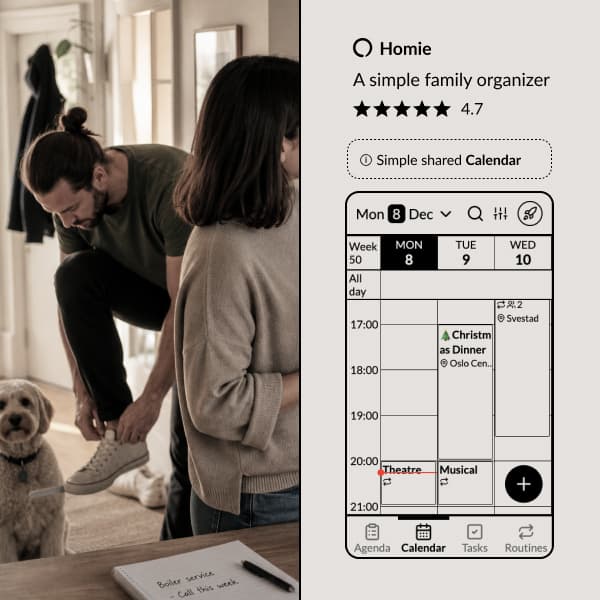
- A shared calendar that everyone can see. Not synced across five different apps—one calendar, visible to all, without requiring individual accounts or technical setup.
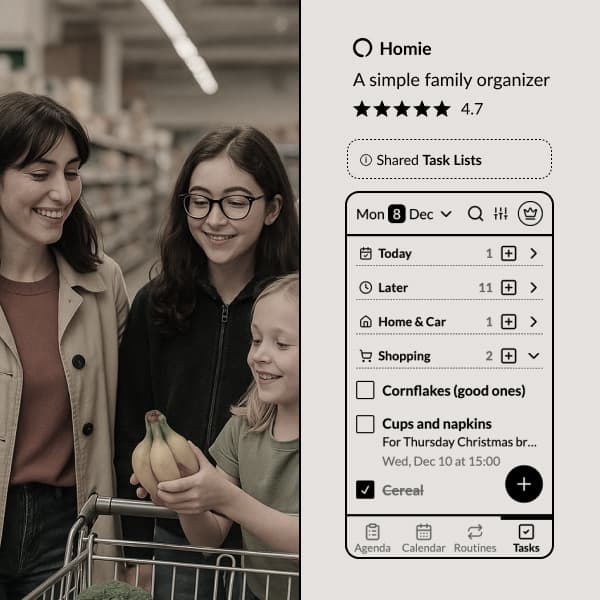
- A way to track who's doing what. Simple task lists and routines that make responsibilities visible. Not gamified, not over-complicated—just clear.
- Passive visibility. The best family organization happens when information is ambient—visible without requiring someone to "check the app." This is why a tablet mounted on the fridge works better than an app on everyone's phone.
- Minimal friction. If it takes more than a few seconds to add something or check something, people won't do it. The interface needs to be simple enough that anyone in the family can use it without training.
The "Boring Tech" Philosophy
We built Homie to be intentionally boring.
No social features. No gamification. No ads. No algorithmic feed. No endless notifications competing for your attention. Just a calm, simple tool that shows your family what's happening and what needs to happen.
We even designed it to work beautifully on e-paper displays—the kind of screens that don't glow, don't distract, and don't tempt you to do "one more thing." Mount a tablet on your fridge or by the front door, and Homie becomes a passive information display. Always there, never demanding attention.
This philosophy extends to how the app works. We don't try to predict what you need or surface "insights." We don't send clever notifications to boost engagement. We just show your calendar, your tasks, your routines—clearly and simply.
Organization Creates Freedom
Some people resist family organization because it sounds restrictive. Schedules. Routines. Checklists. It all seems so rigid.
But the opposite is true.
When everyone knows what's happening—when the logistics are handled by a system instead of floating in someone's head—there's more mental space for spontaneity, for connection, for actually enjoying time together.
Structure creates freedom. A morning routine means kids can get themselves ready without constant reminders. A shared calendar means you can make plans without a twenty-minute discussion about conflicts. A visible task list means responsibilities are clear without someone having to assign them every day.
The goal isn't to schedule every moment. It's to handle the necessary logistics efficiently so you can be more present for everything else.
How Homie Approaches This Differently
We're not trying to build the ultimate productivity app. We're not adding features to compete with every other tool on the market.
We're building the simplest possible system that actually works for families—including kids, including grandparents, including the family member who "doesn't do apps."
One account for the whole family. Multiple people can use it on different devices without each person needing their own login. This is how families actually work—shared resources, shared access.
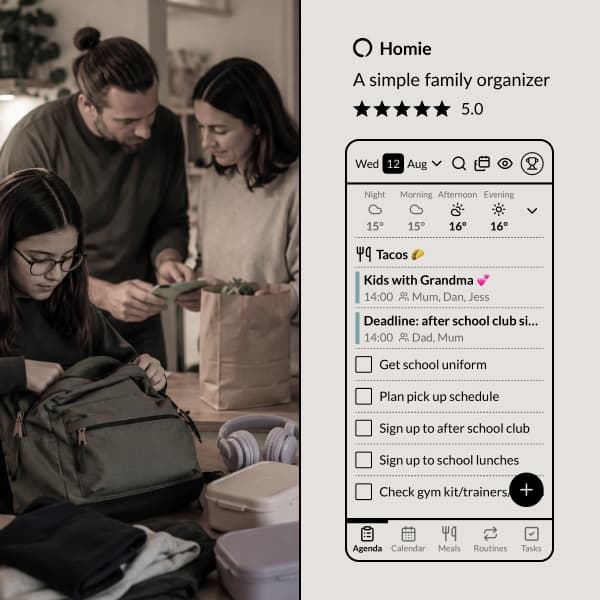
Calendar, tasks, and routines in one place. Not three separate apps, not a complex integration—just one simple view of what's happening and what needs to happen.
Designed for visibility, not engagement. We want Homie to help you spend less time in Homie. Check the calendar, see the tasks, get on with your day.
Works on any device, especially tablets. Phone apps disappear into the chaos of other apps. A tablet on the fridge or by the door is always visible, always useful, never competing for attention.
Here's how we've solved it in the Homie app:
Your agenda
of events, tasks, meals, and routines for the day.
Start Simple
If your family doesn't have a shared system yet, the biggest mistake is trying to do too much at once.
Start with one thing: a shared calendar. Just get everyone's events in one place where everyone can see them. Use Homie, use a paper calendar on the wall, use whatever works—but make it shared and visible.
Once that's working, add one more thing: a simple list of weekly responsibilities. Who's handling dinner each night? Who's doing which chores? Write it down where everyone can see it.
Build habits slowly. A system only works if people actually use it, and people only use things that are simple enough to become automatic.
Family organization isn't about control or rigidity. It's about making the logistics of shared life visible and manageable—so you can focus on what actually matters: each other.
Explore Homie
Making busy family life
CALMER
Homie is a simple, yet powerful operating system for your family, so you can stop chasing schedules as the family's notification system.
Ready to organize your family?
Try Homie free and see how simple family organization can be.