Morning Routines That Actually Work for Families
The secret to calm mornings isn't waking up earlier—it's building systems that run without you. Here's how to create routines your kids will actually follow.

Long story short
- Morning chaos isn't a discipline problem—it's a cognitive load problem
- Routines work because they reduce decision-making and move actions to automatic processing
- Good routines are sequential (not time-based), visible, realistic, and owned by the child
- The visible routine trick: display routines where everyone can see them without asking
- The goal is shifting from verbal reminding to kids checking their own lists
If your mornings feel like a controlled explosion of chaos, you're not alone. The rush to get everyone dressed, fed, packed, and out the door on time is one of the most stressful parts of family life.
Most advice focuses on waking up earlier. Setting more alarms. Being more organized. But after years of struggling with mornings in our own family, we discovered the real solution: build a system that runs without constant parental intervention.
Why Mornings Are So Hard
Morning chaos isn't a discipline problem or a time management problem. It's a cognitive load problem.
Between waking up and leaving the house, a typical family needs to coordinate dozens of small tasks across multiple people—all while everyone's brains are still booting up. Clothes, breakfast, teeth, bags, shoes, keys, phones, lunch boxes, permission slips...
When there's no system, one person (usually a parent) becomes the task manager, verbally directing traffic and constantly reminding everyone what comes next. This is exhausting and ineffective. Kids tune out constant verbal instructions. Parents get frustrated. Everyone starts the day stressed.
The Science of Routine
Routines work because they reduce the need for decision-making and willpower—both of which are limited resources that are especially depleted in the morning.
When a sequence of actions becomes habitual, it moves from the prefrontal cortex (conscious thinking) to the basal ganglia (automatic processing). The action becomes something you just do, without thinking about it. Like how you don't have to think about the steps of brushing your teeth—you just brush your teeth. Over time, a visible checklist builds internal triggers that make the checklist itself unnecessary.
For kids, routines provide something equally important: predictability. When children know what comes next, they feel more secure and more capable. The morning stops being a series of demands from a parent and starts being a familiar pattern they navigate themselves.
Building Blocks of a Good Morning Routine
The best morning routines share certain characteristics:
- They're sequential, not time-based. "Brush teeth after breakfast" works better than "brush teeth at 7:15." Kids (and adults) do better with "do A then B" than with clock-watching.
- They're visible. A routine that exists only in a parent's head requires constant verbal reminding. A routine displayed on the wall or a screen can be followed independently.
- They're realistic. A routine that requires perfect execution every day will fail. Build in some buffer time and don't over-schedule.
- They're owned by the child. Kids follow routines better when they had input in creating them. "We need to do these five things before school—what order makes sense to you?"
Age-Appropriate Morning Routines
Toddlers (2-4 years)
At this age, the routine is really for you, with the child participating. Keep it simple:
- Wake up, use potty
- Get dressed (with help)
- Eat breakfast
- Brush teeth (with help)
- Put on shoes and coat
Visual checklists with pictures work well. Even simple drawings or photos of each step help toddlers understand and anticipate what comes next.
Elementary Age (5-10 years)
This is when kids can start taking real ownership of their routine:
- Wake up, make bed
- Get dressed
- Eat breakfast
- Brush teeth
- Pack bag (check list)
- Shoes and coat
At this age, a visible checklist becomes crucial. Whether it's a paper chart with checkboxes, a display showing their routine, or a whiteboard by the door—the key is that the child can see what they need to do without being told.
The goal is to shift from "did you brush your teeth?" to the child checking their own list and self-correcting.
Tweens and Teens (11+)
Older kids should be fully responsible for their routine, with parents only stepping in for genuine problems:
- Wake up (own alarm)
- Personal hygiene
- Get dressed
- Breakfast
- Pack bag and check schedule
- Leave on time
At this age, the challenge shifts from teaching the routine to not micromanaging. Many parents undermine their teen's autonomy by continuing to remind and nag even when the teen is capable of managing themselves.
Natural consequences become the teacher: if they forget something, they deal with the result. This is how they learn to take responsibility.
The Visible Routine Trick
Here's what transformed mornings in our family: we stopped trying to keep the routine in our heads and started displaying it where everyone could see it.
First, we tried paper charts. They worked okay, but they got ignored, fell off the wall, and couldn't be updated easily.
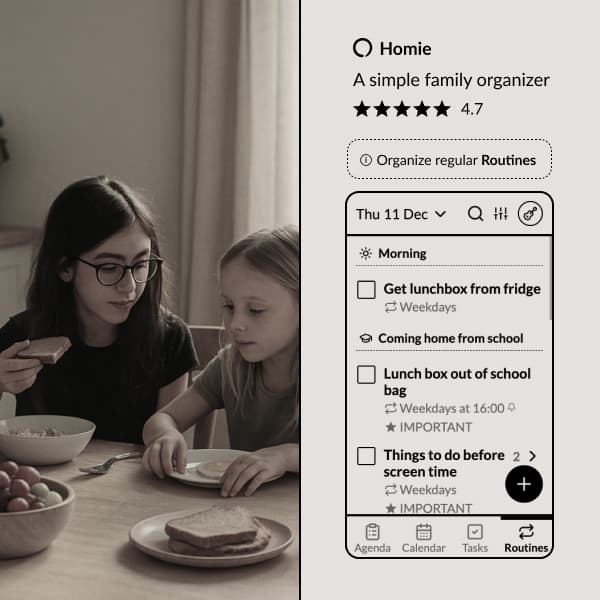
Then we tried a tablet mounted on the fridge, running Homie. This changed everything.
Each family member has their morning routine displayed. They can check off items as they complete them. The screen resets each morning. No one needs to be reminded—they just look at the screen.
The key insight: when information is ambient—always visible without requiring any action to see it—people actually use it. A routine checklist on your phone requires opening an app. A routine checklist on the fridge is just there, visible every time you walk by.
Here's how we've solved it in the Homie app:
that you do regularly.
Routine categories work like checklists in your day.
Important routines, like taking your medicine, will move to the next day until done.
Subtasks for routines with multiple steps like "Spring cleaning".
Skip or move a routine once.
Notifications for important routines.
Getting Everyone to Actually Use It
Creating a routine is easy. Getting everyone to follow it is the hard part.
- Start with buy-in. Involve family members in creating their routine. Ask what order makes sense to them. Let them customize their checklist. People follow systems they helped create.
- Start small. Don't try to implement a perfect routine all at once. Start with the three most important steps. Add more once those are habitual.
- Make it fun (but not gamified). There's a difference between making something pleasant and turning it into a game with points and rewards. Simple satisfaction—the visual completion of a checklist—is usually enough. Extrinsic rewards can actually undermine intrinsic motivation over time.
- Be consistent. Routines only become automatic with repetition. Do the same sequence every day, including weekends if possible (at least a simplified version).
- Use when-then rather than if-then. "When you finish breakfast, then brush your teeth" is more effective than "If you don't brush your teeth, you lose screen time." Positive framing and clear sequences work better than threats.
When Things Fall Apart
No routine survives contact with reality every single day. Kids get sick. Schedules change. Someone wakes up on the wrong side of the bed.
The goal isn't perfection. It's having a default to return to.
When a morning goes badly, don't abandon the routine. Just reset the next day. The routine is the baseline you keep coming back to, not a standard you have to meet every single time.
If the routine consistently fails at the same point, that's useful information. Maybe that step needs to move, or be broken into smaller pieces, or be removed entirely. Routines should evolve as you learn what actually works for your family.
A Real Example: Our Family's Morning
Here's what our morning routine looks like in practice:
The night before: Bags are packed, clothes are laid out. This alone eliminates half of morning stress.
6:30: Kids' alarms go off (their own responsibility to set and respond to).
6:30-7:15: Personal routine—get dressed, make bed, hygiene. Each kid has a checklist on Homie displayed on their own screen or the family display. Calm, screen-free breakfast and tea at their own pace.
7:15-7:30: Final check. Each person looks at their checklist, makes sure everything is done. Bags by the door.
7:30: Leave.
The key elements that make this work:
- Everything possible is done the night before
- Each person follows their own checklist, not verbal instructions
- There's buffer time built in
- Breakfast is calm and unhurried—everyone eats at their own pace
- No screens (except the Homie display) until everything is done
The Morning Sets the Tone
How you start the day affects everything that follows. A rushed, stressful morning carries into school, into work, into everyone's mood for hours.
A calm morning—where everyone knows what to do and can do it independently—sets a completely different tone. Kids arrive at school focused. Parents arrive at work without already feeling depleted. The first interaction of the day isn't nagging and frustration.
This doesn't happen by accident. It happens by design—by creating systems that handle the logistics automatically, so you can be present with your family instead of managing them.
Building a morning routine takes effort up front. But once it's working, it gives you that time back many times over. Not just the minutes saved, but the mental energy preserved by not starting every day with a battle.
That's worth the investment.
Explore Homie
Making busy family life
CALMER
Homie is a simple, yet powerful operating system for your family, so you can stop chasing schedules as the family's notification system.
Ready to organize your family?
Try Homie free and see how simple family organization can be.