Ending the Screen Time Battle: A Family Strategy Guide
The screen time debate misses the point. The real question isn't how many minutes—it's what role technology plays in your family's life.


Long story short
- The screen time debate is framed wrong—context matters more than minutes
- Rules without systems fail because they require constant enforcement
- The "boring tech" philosophy: technology should be functional without being engaging
- Displacement works better than restriction—fill life with compelling alternatives
- Build family media agreements together, including parent commitments
If you've ever tried to get a child off a screen, you know the feeling. The negotiations. The bargaining. The meltdown when time runs out. The guilt about whether you're allowing too much. Or maybe too little.
Screen time has become one of the most fraught aspects of modern parenting. But after years of struggling with this in our own family—and building technology that's meant to help families—we've come to believe the whole debate is framed wrong.
What the Research Actually Says
The research on screen time is more nuanced than most headlines suggest.
Large studies find weak or inconsistent correlations between screen time and negative outcomes. The American Academy of Pediatrics has moved away from strict time limits, now emphasizing quality over quantity. Most researchers agree that context matters enormously—what's on the screen, who the child is with, what else is (or isn't) happening in their life.
That said, there are legitimate concerns:
- Displacement. Time spent on screens is time not spent on other things—physical activity, face-to-face interaction, unstructured play, sleep. These aren't just nice-to-haves; they're essential for development.
- Design manipulation. Many apps and games are specifically engineered to be addictive. Variable rewards, streaks, social pressure, infinite scroll—these features exploit psychological vulnerabilities in both children and adults.
- Passive consumption. There's a meaningful difference between creative use of technology (making videos, coding, building) and passive consumption (scrolling, watching). The latter provides less value and tends to be harder to stop.
The research tells us to worry less about minutes and more about what those minutes are displacing, what the quality of the content is, and whether the child can regulate their own use.
Why Rules Without Systems Fail
Most families try to manage screen time through rules: one hour per day, only after homework, no screens at dinner.
These rules often fail for predictable reasons.
- Enforcement exhaustion. Someone has to track time, enforce limits, and deal with the inevitable pushback. This is tiring and creates constant conflict.
- Boundary testing. Kids naturally test limits. If the only thing standing between them and more screen time is a parent saying "no," they'll keep pushing.
- Inconsistency. Real life doesn't follow consistent patterns. What happens when the rules can't be enforced? When you're tired, or busy, or just need twenty minutes of peace?
- No alternative. Telling kids they can't have screens without providing something better to do creates a vacuum. "I'm bored" becomes the constant refrain.
Rules work best when they're supported by systems—structures that make the desired behavior easier and the undesired behavior harder. This is true for adults trying to change their own habits, and it's true for families trying to shape their media environment.
The "Boring Tech" Philosophy
Here's a counterintuitive approach we've embraced: make technology boring.
We don't mean technology should be useless. We mean it should be functional without being engaging in the "can't look away" sense.
Consider the difference:
- A smartphone is engaging technology. It's designed to capture and hold attention.
- An e-paper tablet is boring technology. It does its job without demanding more of your attention than necessary.
- A smart TV with streaming apps is engaging technology. Endless content, autoplay, recommendations.
- A calendar on the wall is boring technology. Shows information without pulling you in.
Boring technology helps you accomplish what you need to do without creating new attention traps.
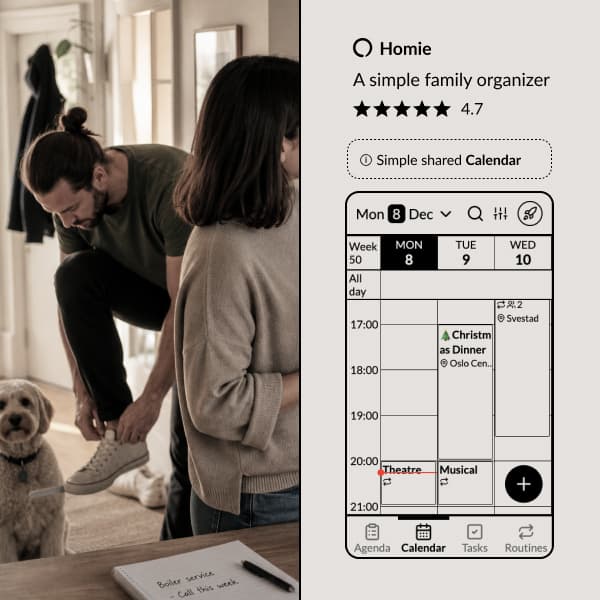
This is why we designed Homie to work beautifully on e-paper displays and mounted tablets. We want families to have a digital hub that shows what's happening today—without competing for attention like a phone or tablet loaded with games and social media.
Creating Structure That Replaces Screens
The most effective approach to screen time isn't restriction—it's displacement. Fill life with compelling alternatives, and screens become less dominant by default.
- Physical environment matters. Where are the screens in your home? If the TV is the centerpiece of the living room, it'll naturally attract attention. If devices live in specific places rather than being carried everywhere, their role shrinks.
- Boredom is productive. We've become so afraid of children being bored that we fill every moment with stimulation. But boredom is the precursor to creativity. It's the discomfort that motivates kids to invent games, make up stories, build things. When screens are too readily available, boredom never has a chance to become creativity.
- Rituals and routines. Family dinners without devices. Reading time before bed. Weekend morning walks. These rituals carve out screen-free space that becomes normal, not exceptional.
- Engaging alternatives. This requires effort, especially at first. Board games, art supplies, building materials, outdoor activities, musical instruments. Not as substitutes for screens, but as parts of a rich environment where screens are just one option among many.
Family Agreements That Actually Stick
Instead of parents imposing rules on kids, try building a family media agreement together.
This works better because:
- Kids who help create rules are more likely to follow them
- The conversation itself builds understanding about why limits matter
- It models collaborative problem-solving
- It can include commitments from parents too (kids notice if rules only apply to them)
A good family media agreement might include:
- When screens are and aren't used. Not just time limits, but contexts. "Screens are fine after responsibilities are done" or "No screens during meals" or "Devices charge outside bedrooms."
- Quality guidelines. What kinds of content are okay? This can be positive ("educational content, creative tools") rather than just negative ("no violent games").
- Social media specifics. If applicable. This is where the most harmful design patterns live. Many families delay social media access entirely until mid-teens.
- Parent commitments. Adults modeling healthy tech use is at least as important as rules for kids. "No phones at dinner" should apply to everyone.
- Review process. Build in times to revisit the agreement. What's working? What isn't? Circumstances change, and the agreement should evolve.
Tools That Help Without Adding More Screens
It seems paradoxical: use technology to reduce technology's hold. But the right tools can genuinely help.
- Parental controls and time limits. Built-in screen time controls on iOS and Android can enforce limits you set. These aren't perfect—kids find workarounds—but they provide a structural support for rules.
- Device-free alternatives. Can you accomplish a task without a screen? Homie works on e-paper displays specifically because we wanted families to have a calendar and task manager that isn't a phone or tablet competing for attention.
- Intentionally limited devices. Some families use "dumb phones" or e-paper phones like the Mudita Kompakt for kids who need to be reachable but don't need a smartphone. The device does what's necessary without the distractions.
- Physical visibility. A whiteboard showing today's schedule. A paper checklist for routines. A displayed family calendar. Sometimes the best tech is no tech.
How We Built Homie to Be Intentionally Boring
When we built Homie, we made deliberate choices against engagement:
- No notifications designed to bring you back. We send functional reminders (your calendar event is starting) not engagement notifications (you haven't opened Homie today!).
- No social features. No likes, no comments, no sharing. Just your family's information.
- No gamification. Completing a task doesn't give you points or badges. We don't try to make chores into a game—we just make it clear what needs to be done.
- Works on boring devices. We specifically optimized for e-paper displays. These screens are functional, not captivating.
- Minimal interface. We resist adding features. Every feature is another reason to spend time in the app. We want you to check Homie, see what you need to see, and get on with your life.
This philosophy won't make us the most "engaging" app. We won't win on metrics like daily active users or time in app. But we believe it makes us genuinely useful for families—a tool that helps rather than a product that extracts attention.
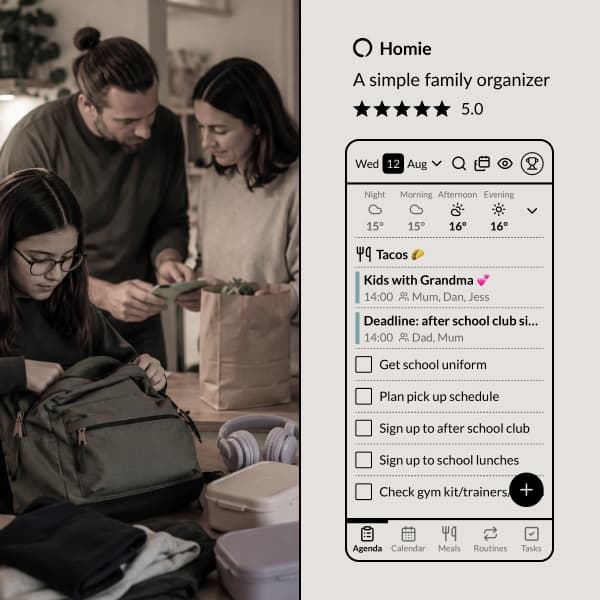
Here's how we've solved it in the Homie app:
Your agenda
of events, tasks, meals, and routines for the day.
The Real Question
The debate over screen time minutes misses the point.
The real questions are:
- Does technology serve your family, or does your family serve technology?
- Does screen use displace things that matter—sleep, activity, connection?
- Can everyone in your family regulate their own use, or are people struggling?
- Do screens create conflict and tension, or are they a neutral part of life?
Some families might answer these questions well with three hours of daily screen time. Others might struggle with thirty minutes. The numbers matter less than the relationship your family has with technology.
Building that healthy relationship requires intentionality. It requires creating environments and structures that support the behaviors you want. It requires modeling healthy use yourself. And it requires ongoing conversation as kids grow and technology evolves.
There's no hack or simple rule that makes this easy. But it is possible—and the families who figure it out have one less source of daily stress and conflict.
That's worth working toward.
Explore Homie
Making busy family life
CALMER
Homie is a simple, yet powerful operating system for your family, so you can stop chasing schedules as the family's notification system.
Ready to organize your family?
Try Homie free and see how simple family organization can be.