Long story short
- The mental load doesn't show up the day a baby arrives, it starts the moment two people share a fridge
- Most household work isn't event-shaped, so a shared calendar app doesn't catch it
- In most couples one person quietly becomes the keeper of the schedule, not from malice but because the information lives in one head
- A visible, shared system stops the gatekeeping and changes what you talk about at the kitchen table
- Homie was built for families, but it works for anyone sharing a home: partners, roommates, adult children caring for a parent
"Did you tell my mum we're coming Sunday?"
We're standing in the kitchen. He has one shoe on. The dog is staring at the door. It is a perfectly ordinary Tuesday morning, and somehow, for the third time this week, I am the gatekeeper of a piece of information he genuinely needs and doesn't have.
I'm Nour. I'm the type that "just remembers" stuff, except when I don't. Long before we had kids, this was already our life. Øyvind (45) has ADHD. I do not. So by some quiet, unspoken default, the calendar of our shared life lived inside my head.
And we hadn't even started doing the hard part yet.
The Mental Load Doesn't Wait for Kids
Most pieces about the household mental load are written for families with small children. They miss something.
The mental load doesn't show up the day a baby arrives. It starts the moment two people share a fridge.
It's the boiler service. It's the friend's wedding next month. It's "did anyone reply to your dad?" It's the bin day, the gas bill, the dentist appointment we keep meaning to make. The wedding gift list. The mole on his back the GP wanted to check in six months.
None of it is hard. None of it is even particularly event-shaped. It's just a constant, low-grade stream of small things that have to live somewhere. In our house, "somewhere" was me.
This isn't unique to us. In most couples I know, even the ones with two equally competent, equally present adults, one person ends up as the keeper of the schedule. It's not malice. It's not laziness. It's that the information lives in one head, and when nobody else can see it, nobody else can help.
"But We're Both Quite Organised"
This is the thing I want to say to anyone who's sure they don't need a system. I was that person.
I am the type who "just remembers". I have tried and discarded every organiser ever invented. I have a graveyard of abandoned planners, a wall calendar I gave up on in 2019, and a notes app that became a digital landfill in about three weeks. The reason I gave up on all of them was the same: they took more effort to maintain than they saved. So I went back to my own head.
For a long time my own head was enough. We were two adults, no kids, two jobs, one dog. How complicated could it be?
Quite complicated, as it turns out, in a slow and invisible way.
The trouble with carrying it all in your head is that it works. Right up until it doesn't. You forget one thing, and then because you're embarrassed about the one thing you forget, you double down on remembering the next ten. The cognitive cost goes up. The reliability stays exactly the same.
And the other person, the one who didn't volunteer to be the gatekeeper, has no way in. They can't help if they can't see what's there.
The Month I Made Him Wait
When Øyvind first showed me Homie, I was unimpressed.
He is a self-described "super structure geek", which is probably a coping mechanism for his ADHD. This is a man who has tried (and made me try) every productivity tool ever invented. So when he came to me with another one, even one he had built himself, my answer was a polite no.
It took at least a month of watching him use it before I gave it a go. He didn't push. He just used it for himself, and slowly the things he used to ask me about, he stopped asking me about. The bin day. The vet appointment. Whether we had any plans this weekend.
That was the bit that got me. Not the features. The fact that I wasn't being asked.
So I tried it. I am, by my own admission, the toughest critic this thing has. If anything had felt halfway done or fiddly or precious, I would have binned it. It didn't. So I stayed.
What Actually Changed
This is the bit where I'm supposed to list features. I'll keep it short, because the features matter less than what they made possible.
The fridge stopped being a courier service. We have a tablet on the wall in the kitchen, and our shared calendar is on it. It is the first thing both of us look at in the morning. He doesn't have to ask me what's on this week. I don't have to remember to tell him.
The "small things" finally had a home. All those non-events that used to live in my head, the boiler service, the friend's birthday, the prescription that needs renewing, went onto a shared list. Either of us could pick one up. For the first time since we'd moved in together, the unglamorous admin of running a life wasn't allocated by default. It was just visible.
The conversation at the kitchen table changed. We stopped spending the first ten minutes of every evening doing logistics. "Did you book the…", "What time is…", "Have you replied to…". It's not that we never have those conversations now. It's that they take a minute, not ten, because the answer is on the wall.
I didn't notice this happening at the time. I noticed about three months in, when a friend asked how we were and I realised the answer was, genuinely, calmer.
"But We Already Share a Calendar"
I know what you're thinking. We already share a calendar app. So do we, in theory. We had Google Calendar for years.
A shared calendar is great for events. Most of what runs a household is not events.
Events have a time and a date. Tasks don't. The boiler service is a thing that has to happen sometime in the next month. The wedding gift is a thing that has to be bought before Saturday. The bin day is the same thing every Tuesday and nobody needs a notification about it, they just need to be able to glance and see whose turn it is.
A calendar is not the right shape for that. A calendar in your phone is even less the right shape for it, because both of you have to remember to open the app. A list on the fridge is closer to the right shape, but it doesn't sync, and it definitely doesn't tell you what your partner just added from the supermarket.
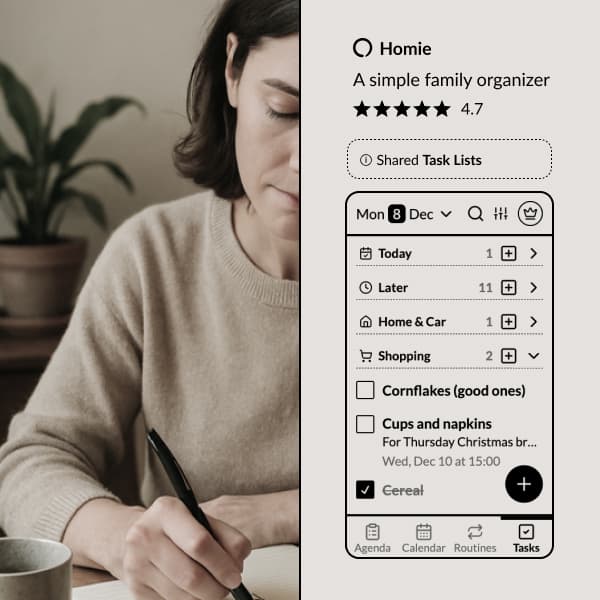
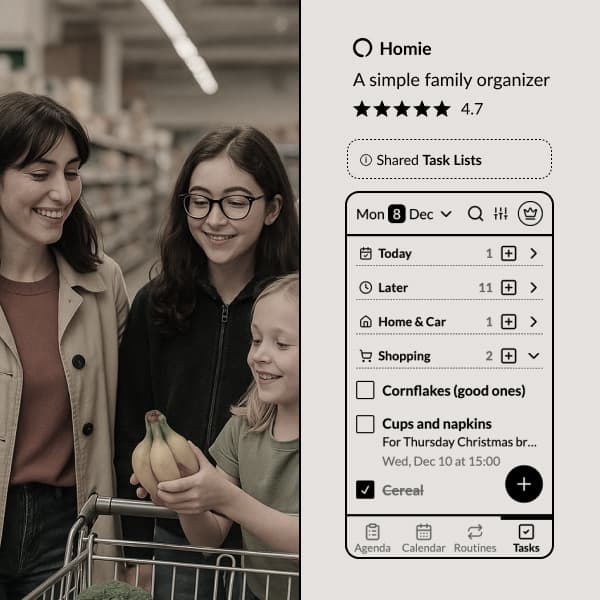
Homie is, more or less, the fridge whiteboard, only it remembers things and both of you can see it from anywhere. That sounds small. It is not small.
This is also why writing things down works even before you have a system that does anything clever with what you wrote. The point isn't the cleverness. The point is that your brain finally lets go.
It's Called Homie Because It's for the Home
We built the family version first because that's what we needed. Øyvind wanted to stop being the bottleneck. Julia (11) needed to remember her gym bag and her tennis gear without me being a human reminder. She built a checklist with her own hand on the whiteboard before we'd even shipped the routines feature, which was a fairly strong hint that we were onto something.
But the truth is, this starts long before kids do. And it doesn't end with them either. Øyvind's sister Kristin (52) uses Homie to coordinate care for his parents in their straw bale house in Norway, half a country away from her, with cousins who pop in. There are no children in that household. The mental load is enormous.
Anyone sharing a home, partners, roommates, an adult and the parent they're looking after, two siblings dividing up a household, has more cognitive work to spread than any single brain wants to hold. The "default planner" pattern shows up wherever there's a shared life and no shared system. It is not a phase. It does not require children to activate it.
If you've read this far and recognised yourself, in either role, this is for you too.
Where to Start
You don't need a tablet on a wall. You don't need to mount anything to anything. You can start tonight, on the device you already have, with three things:
- A shared calendar that both of you actually open.
- One shared list for the small running admin of your life, the things that aren't important enough to schedule but real enough to forget.
- The agreement that whoever thinks of a thing puts it in, instead of telling the other person to remember it.
That's the whole shift. Stop telling each other things you'll both forget. Put them in the place you both look.
If, like me, you are sceptical of yet another app, fine. Try it for a month. Be the toughest critic. If it isn't earning its place, bin it. (We offer a full refund. Øyvind insisted.)
PS: He was right. It only took me a month to admit it.
Ready to organize your family?
Try Homie free and see how simple family organization can be.