When Your Kid Outgrows the Checklist (That's the Whole Point)
Julia (11) snapped that she doesn't need a checklist to remember everything in her life. At first it stung. Then I realized: that's exactly what was supposed to happen.

Long story short
- External triggers (checklists, reminders) are scaffolding, not permanent infrastructure
- Nir Eyal's "Hooked" model explains how external triggers build internal ones over time
- The goal of a family system isn't dependency—it's building habits that eventually run on autopilot
- When a child says "I don't need the list," that's not failure. That's graduation.
- But maybe keep the list around for tennis gear
It was a regular Monday morning. Julia (11) was rushing through her routine, getting ready for school—the usual controlled chaos of a pre-teen who has precisely calculated the minimum time needed before she needs to leave the house.
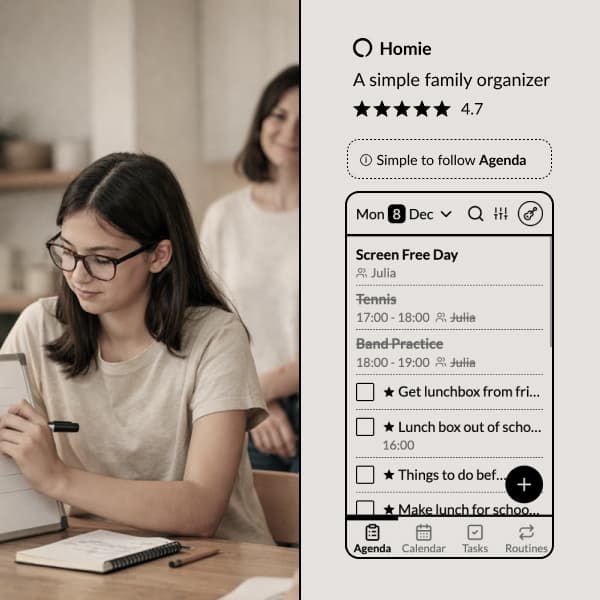
I was standing by the fridge, looking over her Homie agenda on the tablet mounted on the wall. Something was missing.
"Hey—your lunch box step isn't on your routine anymore. Did something happen to it?"
She turned around with the full force of twelve-year-old attitude.
"I don't need a checklist to remember everything in my life. I remember to bring my lunch."
There it was. A sentence that, on the surface, sounded like my family organizer app had just been fired by a seventh grader.
The Sting Before the Insight
I'll be honest: my first reaction was a small wince. When you've built something to help your family stay organized, hearing "I don't need it" triggers a defensive reflex. Is the system broken? Did she delete things by accident? Is this a pre-teen rebellion against structure?
But then I thought about it for more than three seconds.
She used to forget her lunch. Regularly. We'd get texts from school, or she'd come home starving because she'd eaten nothing since breakfast. So we added it to her morning routine in Homie. Every morning, the tablet on the wall showed it. Every morning, she checked it off.
And then, at some point—neither of us noticed exactly when—she stopped needing the prompt. Grabbing her lunch from the fridge had become automatic. Like brushing teeth. Like putting on shoes. The action had moved from something she had to consciously remember to something she just did.
She didn't need the external trigger anymore. She'd built an internal one.
The Hooked Model (and Why It Matters for Families)
Nir Eyal's book Hooked: How to Build Habit-Forming Products is usually discussed in the context of tech companies trying to get users addicted to their apps. But the underlying model describes something more fundamental: how any behavior becomes a habit.
Eyal outlines four phases:
1. Trigger
Every habit starts with a trigger—something that initiates the behavior.
External triggers come from outside: a notification, a checklist item, a parent's reminder, a sticky note on the fridge. They're obvious and explicit. "Do this thing now."
Internal triggers come from within: emotions, situations, or routines that automatically prompt behavior without any external prompt. You don't need someone to tell you to check your phone when you're bored—boredom itself is the trigger.
The crucial insight: external triggers exist to build internal ones. They're scaffolding, not the building itself. Over time, with enough repetition, the external trigger becomes unnecessary because the internal trigger has formed.
This is exactly what happened with the lunch box. The checklist item was an external trigger, repeated daily for months. Eventually, the context itself—morning, kitchen, getting ready for school—became the trigger. The checklist could come down because the habit had been built.
2. Action
The action is the behavior itself—the simpler, the better. Eyal argues that for a habit to form, the action needs to be easy enough that motivation barely matters.
A morning routine checklist works precisely because each step is trivially simple. "Take lunch from fridge" is not a complex task. The barrier to action is nearly zero. The only barrier was remembering, and the external trigger solved that until the habit formed.
3. Variable Reward
This is where the model gets interesting for family tools—because honest family organizers don't really have variable rewards. There's no slot-machine dopamine hit when you check off "pack lunch." No confetti. No streak counter. No social validation from followers.
And that's fine. In fact, that's by design.
The reward in a family routine is quieter: the satisfaction of being ready on time. The absence of stress. Not getting a text from school about a forgotten lunch. These rewards are real but predictable—which means the habit loop depends more heavily on the trigger and action phases. It takes longer to build, but once built, it's sturdy. It doesn't need constant re-engagement mechanics to sustain itself.
4. Investment
The investment phase is about the user putting something into the system that makes it more valuable over time and loads the next trigger.
For a family organizer, the investment is the routine itself—the time spent setting up the checklist, customizing the steps, adjusting based on what works. Each adjustment makes the system more personal and more effective, which makes the trigger more relevant, which makes the action more likely.
A child who helped set up their own routine is more invested in following it than one who had it imposed on them. That's not just good UX design. That's basic parenting.
Scaffolding, Not Crutches
There's an important distinction here that I think many family organization tools get wrong.
A crutch is something you become dependent on. Remove it, and you fall. The tool's success is measured by continued usage—the more you use it, the more "valuable" it is. This is the attention economy model: engagement equals success.
Scaffolding is something you build with, then remove. Its success is measured by what you can do without it. A great morning routine checklist should, over time, make itself partially unnecessary. Not entirely—life is complex and new responsibilities keep appearing—but the basics should become automatic.
When Julia said she didn't need the lunch box reminder, that wasn't Homie failing. That was Homie succeeding. The external trigger had done its job. The habit was built. The scaffolding could come down for that particular step.
This is the philosophy behind calm technology applied to families: the best family tool is one that helps you need it less for the things that have become habits, while staying useful for the things that haven't yet.
When the Checklist Saves You
There's a flipside to the scaffolding story, though. Even habits that feel bulletproof can break down under stress.
Imagine your kid wakes up half an hour late. The calm morning sequence they've internalized—the one that runs on autopilot—suddenly doesn't work. They're panicking, skipping steps, shoving things into their bag at random. Stress floods the brain and wipes out the automatic routines. This is when the checklist on the wall goes from "scaffolding I've outgrown" to "the only thing standing between me and total chaos."
It's the same for adults. Think about packing for a trip. You've traveled dozens of times. You know what you need. But when you're rushing to leave, stressed about the flight, trying to remember if you packed the charger while simultaneously wondering if you locked the back door—that's when a packing list isn't a crutch. It's relief. You don't have to plow through your stress and emotions to figure out if you have everything. You just follow the list.
Pilots use checklists before every flight, not because they've forgotten how to fly, but because the stakes are too high to rely on memory under pressure. Surgeons use them in the operating room for the same reason. The checklist isn't there because they're not competent. It's there because competence and memory are two different things, especially when stress enters the picture.
So yes—habits form, scaffolding comes down, kids outgrow their checklists. But the checklist stays available for the mornings when nothing goes as planned. That's not dependency. That's a safety net.
What This Means for How We Build Homie
This experience reinforced something we already believed but hadn't articulated as clearly:
The measure of a family organizer isn't how much time people spend in it. It's how much smoother family life runs because of it.
We don't optimize for engagement. We don't send push notifications begging you to come back. We don't gamify routine completion with badges and leaderboards. We intentionally build something calm—a system that sits quietly in your pocket or on your wall, does its job, and gets out of the way.
Some items will be there forever because they're not about habit-building—they're about coordination and memory. "Tennis at 17:00" isn't a habit to internalize; it's information that changes week to week. Getting the car serviced every year, renewing the insurance, booking the dentist—these aren't daily habits you'll ever build internal triggers for. They happen too infrequently. You don't want to carry them around in your head. That's permanent infrastructure.
But the daily routine items—the sequences that turn from conscious effort into automatic behavior—those are scaffolding. And when a twelve-year-old tells you she doesn't need the scaffolding anymore, you take it as the win it is.
The Punchline
So there I stood, privately proud that our family system had worked exactly as intended. Julia had internalized a habit. She was asserting independence. She was growing up.
She grabbed her jacket, announced she was ready, and headed for the door with the confidence of someone who has everything under control.
Sixty seconds later, the front door flew open again.
She scrambled past me in the hallway, shoes tracking snow across the floor, frantically searching for her tennis bag.
"Where's my racket?! I have tennis today!"
It was, of course, on her checklist. The one she didn't need to check anymore.
I said nothing. I ran upstairs, found her clothes, grabbed her racket, put it all in a bag, and handed it to her. The lesson was obvious and didn't need to be spelled out.
Some scaffolding, it turns out, isn't quite ready to come down yet. And that's fine too. That's exactly what it's there for.
Explore Homie
Making busy family life
CALMER
Homie is a simple, yet powerful operating system for your family, so you can stop chasing schedules as the family's notification system.
Ready to organize your family?
Try Homie free and see how simple family organization can be.